Fiber based
Optical
netwoRk for
European
Science and
Technology
Optical
netwoRk for
European
Science and
Technology
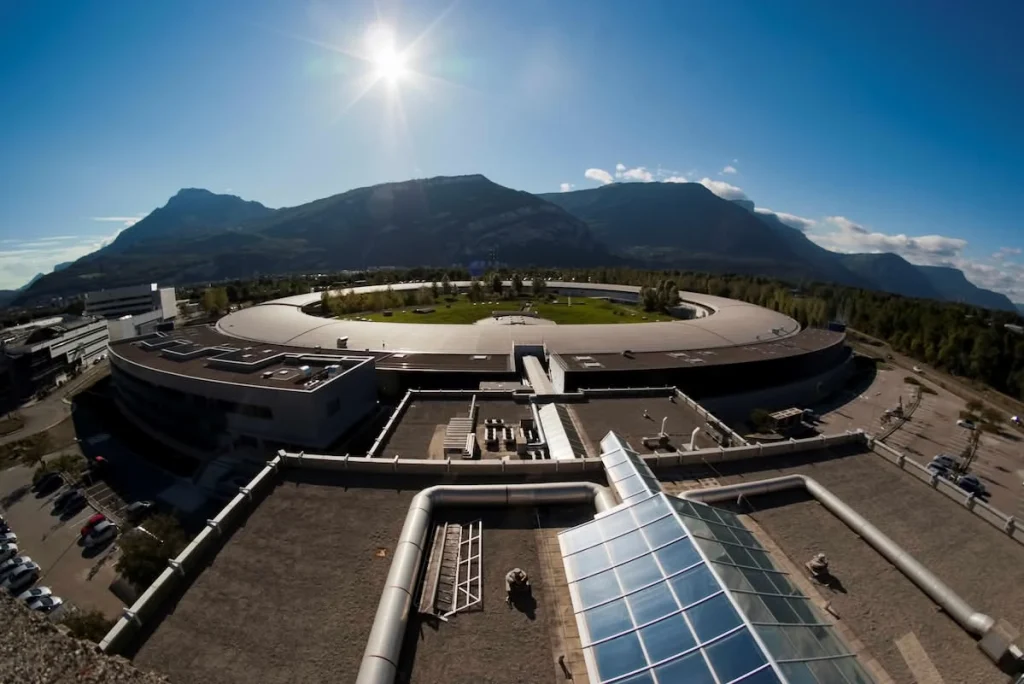
We are delighted to announce that the European research infrastructure project FOREST has been selected by the ESFRI Forum for inclusion in the ESFRI Roadmap 2026. To date, the project consortium brings together GÉANT and 60 stakeholders from 17 countries. It is supported by 13 ministries representing 10 governments, major European institutions such as EURAMET, JRC, and European Research infrastructures including CERN, ESRF, LOFAR, JIVE, and EPOS. Last but not least, FOREST is strongly supported by more than 20 companies.
We would like to express our warm thanks to all stakeholders and supporters for their decisive contribution, which made this great achievement possible.
Now is the time for action to deliver the services expected by the scientific community and, beyond, by society.
Today’s world requires ever greater precision in the control of time and hours in extremely varied areas of society: national and international transport, geo-localization, banking transactions, … This concerns many other sectors, often high-tech, that our fellow citizens do not suspect.
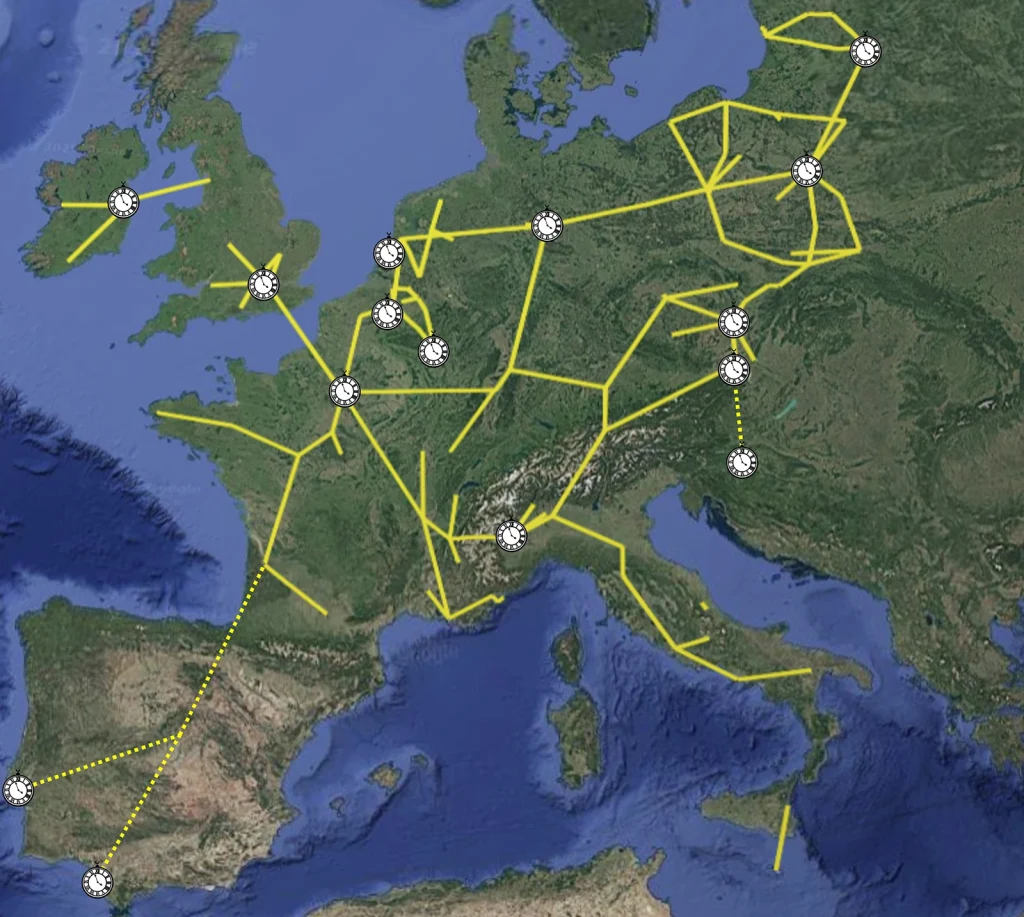
FOREST is a project of research infrastructure based on the distribution of ultra-stable and accurate time and frequency (T & F) signals, developed with atomic clocks by national metrology institutes (NMIs) which provide the legal time in each country. The current development of interconnections of the national T&F networks led by GÉANT will be a major added value in terms of infrastructure. Today, FOREST represents a cumulative network of more than 31,000 km long optical network, a size which is continuously growing. It is already 50% larger than the second world largest project of T&F network, taken place in China, expected to be ended in 2027.
Thanks to extensive R&D developments over the past 25 years, it is now possible to distribute very high-accuracy time-frequency signals via optical fibres without degrading the performance of NMI clocks over continental distances.
The performances of this technology surpass by several orders of magnitude those of Global Navigation Satellites Systems (GNSS) as GPS, Galileo This more performing and more resilient technology than GNSS may complement it and play a key role for European security and sovereignty. The domains of applications of FOREST are extremely broad and will address numerous scientific communities. we identified three main axes:
Last but not least, FOREST is willing to favor strong interactions between public and private sectors since innovation is at the heart of the 3 axes of FOREST which could be positioned as a Technology Infrastructure.
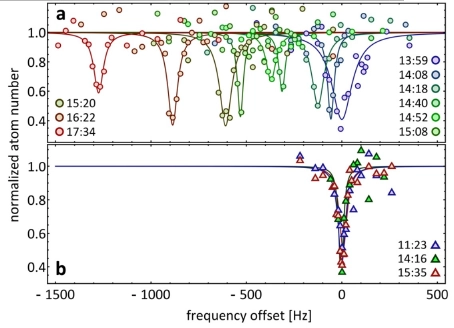
Spectroscopy of a cold Yb ga :
(a) : with the frequency scale referenced to GNSS. One line was recorded over a few minutes several times within 3,5 hours. The apparent position is fluctuating due to the instability of GNSS
(b) : referenced to a fiber-connected optical clock signal. The line recorded 3 times within 4 hours was found strictly at the same position. The accuracy is 100 times higher than with GNSS.
Present-day Global Navigation Satellites Systems (GNSS) as GPS, GALILEO, etc. rely on atomic clock technology developed from the 1950s, which imposes fundamental limits on the residual time errors (nanoseconds) achievable with GNSS receivers compared to GNSS atomic time. The frequency stability of GNSS is also inadequate for comparing optical clocks, which have significantly improved over the last two decades, achieving relative uncertainties of 10^-17 to 10^-18 and stabilities far exceeding those of GNSS clocks.
Alternative solutions using connections of these clocks by stabilized optical fibre links proved to be extremely effective. The uncertainty introduced by very long links ( > 1000km) is still 2 orders of magnitude below those of the best clocks. A first demonstration between the French and German optical clocks using a 1400 km long link showed in 2015 a relative frequency difference of 2.10^-15 due to the gravitational shift revealing a height difference of only 20 m. This opened a new field of research called “chronometric geodesy” because the current accuracy of the clocks of 10^-18 allows a resolution of 1 cm. Beyond all of the scientific sectors which require precision measurements, this scientific opening in the field of Geosciences is only the first example of applications permitted by the breakthrough of these optical clocks and optical fibre links.
Additionally, novel fibre-optic techniques like the white rabbit technology have been created to transfer time over long distances with residual errors in the deep sub-nanosecond range.
FOREST will leverage national optical fibre networks dedicated to distributing ultra-precise time and frequency (T & F) signals established by National Metrology Institutes (NMIs): an optical frequency, a time scale and a radiofrequency, all referenced to the national UTC(k). A significant advantage of FOREST will be the establishment of cross-border connections between these national networks, a development initiated by several NMIs and now coordinated by GÉANT, the consortium of NRENs linked to the European Commission. This will facilitate continuous comparisons of European NMI clocks, enhancing Europe’s standing in global metrology.
The diverse scientific domains connected by FOREST highlight the fundamental importance of UTC as the international time scale and the SI second as its unit. In fact, several European clock comparisons campaigns took place over the last ten years which confirm that the optical links do not contribute to the error budget at all: EMPIR ROCIT (2019-2022), IEM TOCK (2023-2026)
FOREST will provide access to ultra-precise measurement capabilities across various scientific fields, including fundamental physics, astrophysics (e.g., Very Long Baseline Interferometry – VLBI), and high-energy physics (e.g. the connection to CERN is already established).
Quantum Key Distribution (QKD) is a quantum communication protocol designed to establish a shared cryptographic key between two remote parties with an absolute level of security. Its security is guaranteed by the fundamental principles of quantum mechanics—specifically, the no-cloning theorem and the Heisenberg Uncertainty Principle—which ensure that any eavesdropping attempt can be detected due to disturbance caused by the measurement of a quantum state, that increases the level of errors in the shared key.
QKD protocols enable the distribution of random secret keys over optical channels, typically implemented through single-photon transmission or entanglement-based schemes. Once the photon transmission phase is complete, classical post-processing steps—including error correction and privacy amplification—are applied to generate a final shared key that is provably secure.
Ongoing research focuses on improving key rates, extending transmission distances, developing satellite-based QKD systems, and integrating quantum channels into existing telecom infrastructures to enable scalable, secure communication networks.
Among other quantum communication protocols QKD is the most advanced and closer to a readiness level that allows deployment and use in real world. FOREST infrastructure will be exploited to test in real world this technique together with other Quantum Communication protocols.
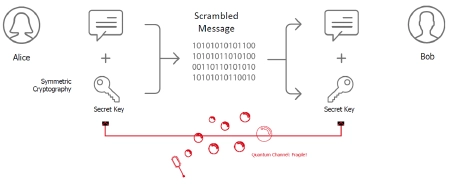
Cryptography is the science that makes our digital communications secure. It allows to protect information so that only the intended people — often called Alice and Bob — can read it.
Quantum Key Distribution (QKD) uses quantum particles, typically single photons (particles of light), to share a secret key. This key can then be used with any encryption method to send private messages.
Quantum physics tells us that a quantum particle cannot be measured without disturbing it and that it is impossible to make a perfect copy of an unknown quantum state (the “no-cloning theorem”).
These two principles are at the basis of QKD: if an eavesdropper (called Eve) tries to intercept the photons that Alice sends to Bob, her presence will inevitably disturb the transmission and can be detected when they compare a small portion of their data. So, unlike traditional encryption, where you might not know if someone is listening, in QKD you are always able to understand if your transmission has been compromised.
If no eavesdropping is detected, Alice and Bob keep the remaining bits, apply some classical post-processing steps (error correction and privacy amplification), and end up with an identical and secret random key.
The key insight is that security in QKD doesn’t depend on mathematical assumptions, but on the laws of physics themselves. No matter how powerful a computer is: it cannot copy or measure a quantum state without leaving a trace.
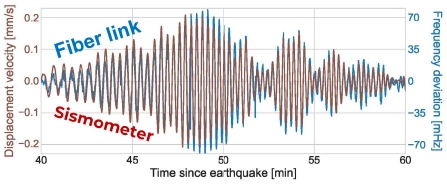
September 2022, detection of a earthquake in Mexico:
Signal correlation: 0,94. (From Mads Tønnes PhD thesis)
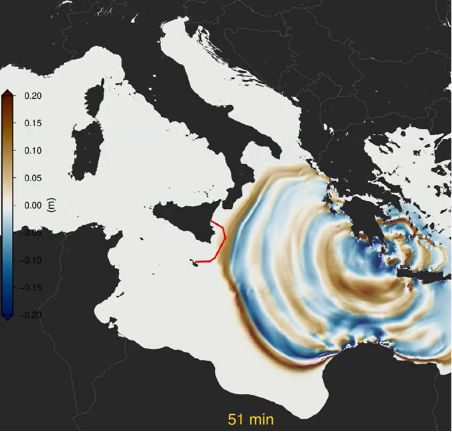
Impact on a submarine optical fibre between Sicilia and Malta island of an earthquake in Greece (courtesy of INGV). Optical fibres are dense on land and extend to remote areas; when equipped with sensing abilities, they become valuable tools for environmental monitoring and hazard detection.
The FOREST initiative will leverage fibre infrastructure distributed across Europe to facilitate experimentation and proof of concepts on advanced fibre sensing capabilities across scientific, industrial, and environmental domains. By transforming the FOREST fibre network into a continent-wide sensor array, researchers will gain real time access to distributed measurements of acoustic, strain, and temperature variations. These capabilities will support a broad range of applications: seismic monitoring, infrastructure health (including e.g., fibre infrastructure, electrical, gas pipelines, etc.), assessment to traffic analytics and environmental observation.
The entire FOREST optical fibre network will be made accessible for fibre sensing services, enabling dedicated projects that align with the specific characteristics and availability of individual fibre segments. This model is designed to stimulate cross-disciplinary collaboration and accelerate innovation in distributed fibre optic sensing (DFOS). A key feature of FOREST is the integration of fibre sensing functionalities into operational communication links, an essential step toward enabling large-scale convergence of sensing and communications. Within FOREST, sensing capabilities will share the same physical infrastructure as two other core services: precision time and frequency distribution, and quantum networking. This co-location promotes efficient resource utilization and lays the foundation for truly multifunctional optical networks.
The FOREST project is the culmination of a long journey over the past fifteen years, initially undertaken by NMis (National Metrology Institutes), NRENs (National Research and Education Networks) and a few academic labs involved in high precision experiments. The development of time-frequency signal dissemination via optical fibre and frequency comparisons of European optical clocks, benefited from several European projects: EMRP NEAT-FT (2012-2015), EMPIR ITOC (2013-2016), EMPIR OFTEN (2016-2019), EMPIR TIFOON (2019-2022). The perspective of creating a European research infrastructure was initiated by a H2020 Infrainnov project CLOck NETwork Services (CLONETS) was led by Paris Observatory, started in 2016 followed by a H2020 Design study project (CLONETS-DS) led by GÉANT.
Although the first intent of these initiatives was to build a European research infrastructure dedicated to the time and frequency distribution and comparison at the European scale, the rapid rise of fields such as quantum communications and fiber sensing, which require high-precision timing, has made it clear the interest of broadening the scientific scope. This will represent a fantastic mutualization of means and competences at service of a very large scientific and technological community.
The FOREST project gathers today 60 stakeholders from 17 European countries. CERN is intended to join the consortium if FOREST is selected by ESFRI. It received the political supports of 13 ministries from 10 European Governments, 3 of these providing in addition a financial support. We obtained 105 letters of support including more than 20 from private companies. Discussions are still ongoing in several countries involved in FOREST with their respective ministries in order to broaden the FOREST consortium. The core of the consortium is formed by 3 groups.
Among the institutions supporting the initiative, are the following European Research infrastructures: EPOS, JIVE, LOFAR, ESRF. Let us also mention the BIPM, while EURAMET, European consortium of the NMIs, and the Joint Research Center (JRC) from the European Commission are ready to play a key role in the International Advisory Board of FOREST.
| Country | Ministry | NMI (or equivalent) | NREN | Univ/Res./Public Serv. |
Austria |  |  |  | |
Belgium |  |  |  | |
Czech Republic |  |  |  | |
Germany |  |  |  | |
Spain |  | |||
Europe |  | |||
France |  |  |             | |
United Kingdom |  |  |  | |
Croatia |  |  | ||
Ireland |  |  |  |   |
Italy |  |  |  |         |
Lithuania |  |  |  | |
Luxembourg |   |  |  | |
Malta |  | |||
Netherlands |    |  |  |   |
Poland |  |  |   | |
Portugal |  |  |  | |
Slovakia |  |   |
| Country | NMI (or equivalent) | NREN | Univ/Res./Public Serv. | Private company | European commission |
Belgium |      |   | |||
Czech Republic |   |        |   | ||
Spain |  | ||||
Europe |  |      |  | ||
France |  |      |              | ||
United Kingdom |    | ||||
International organization |  | ||||
Italy |   |   | |||
Luxembourg |    | ||||
Netherlands |  | ||||
Poland |  |